


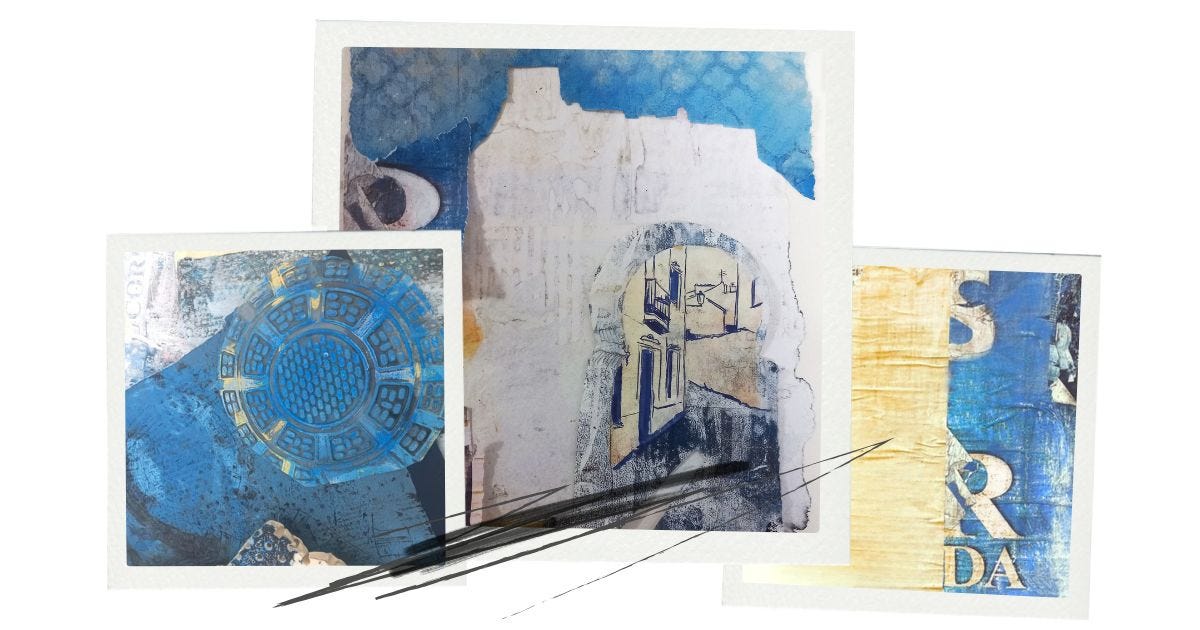
Untitled (Study), 2025. Mixed media on paper.
Competition Brief
The competition theme was Urban Landscapes: Imagine, Trace, Reveal. At the time, I was already developing a small series of works on paper inspired by urban archaeology — layered surfaces, architectural hints and fragments suggesting what had been removed or covered over. The pieces were built through painted, printed and found paper, combined with dry media and paint.
I rarely enter competitions. This one offered a useful constraint.
The principal requirement was a four-colour limit. I chose black, white, blue and yellow. The colours were not arbitrary; they echoed works in progress and gave me a workable range of warm and cool blues and yellows. What they removed was my usual habit of allowing small flecks of colour to peek through layered surfaces. That option was no longer available.
The brief did not interrupt my enquiry. It introduced a contained problem within it.
Unlike many life problems, this one was useful.
Adjusting the emphasis
My process did not change. I still began by gathering fragments — scanned textures, printed surfaces, reduced silhouettes, pieces of lettering — and testing their relationships. What changed was how much responsibility colour was allowed to carry.
With a restricted palette, colour could no longer compensate for uncertain placement. Blue and yellow had to carry structure. Black anchored or interrupted. White became active rather than passive space. Hierarchy depended more clearly on value, scale and proportion.
Working within a limit doesn’t automatically improve the work. What it does is make your usual habits easier to see. Without the safety of additional colour adjustments, compositional weaknesses become harder to disguise.
Filtering the fodder
There is always more material than can be used. The restriction made that surplus more apparent. Some fragments lost relevance quickly; without variation in tone and temperature they could not sustain interest. Others strengthened because they operated through shape and proportion rather than atmosphere.
The palette acted as a filter. It reduced the visual fodder. Some fragments simply couldn’t survive without tonal variation. Others strengthened because they operated through proportion and placement rather than atmosphere.
When an idea fails structurally
At one stage an arch motif appeared repeatedly. It related to the wider urban vocabulary of the series and I wanted it to remain. I know it will eventually find its place in another piece.
But in this composition it began to dominate. Other elements stopped speaking to each other because the arch insisted on being the focal point.
It was less a problem of drawing and more a problem of balance. Sometimes in painting you have to cover up a mark you love in order to let the whole settle. This was a similar moment.
I removed the motif, but that was only one possible solution. The point was not the arch itself; it was recognising that I was protecting an idea rather than strengthening the whole. Once that became clear, other options were possible.
What remains
I did not receive a mention. That is incidental.
What stayed with me was the usefulness of the constraint. It created a contained space in which to test direction without committing it fully to the wider series. This piece remains slightly separate from the others, and may not sit within the final body of work. But it allowed me to explore how drawn elements might operate within abstraction without overwhelming it.
From time to time, narrowing the conditions under which you work can expose where structure is carrying the composition — and where you are compensating. That is not a dramatic lesson. It is simply a practical one.
I documented the full process behind this project — from fragment gathering through structural refinement — here:
Urban Collage: Andalucía in Paint and Paper
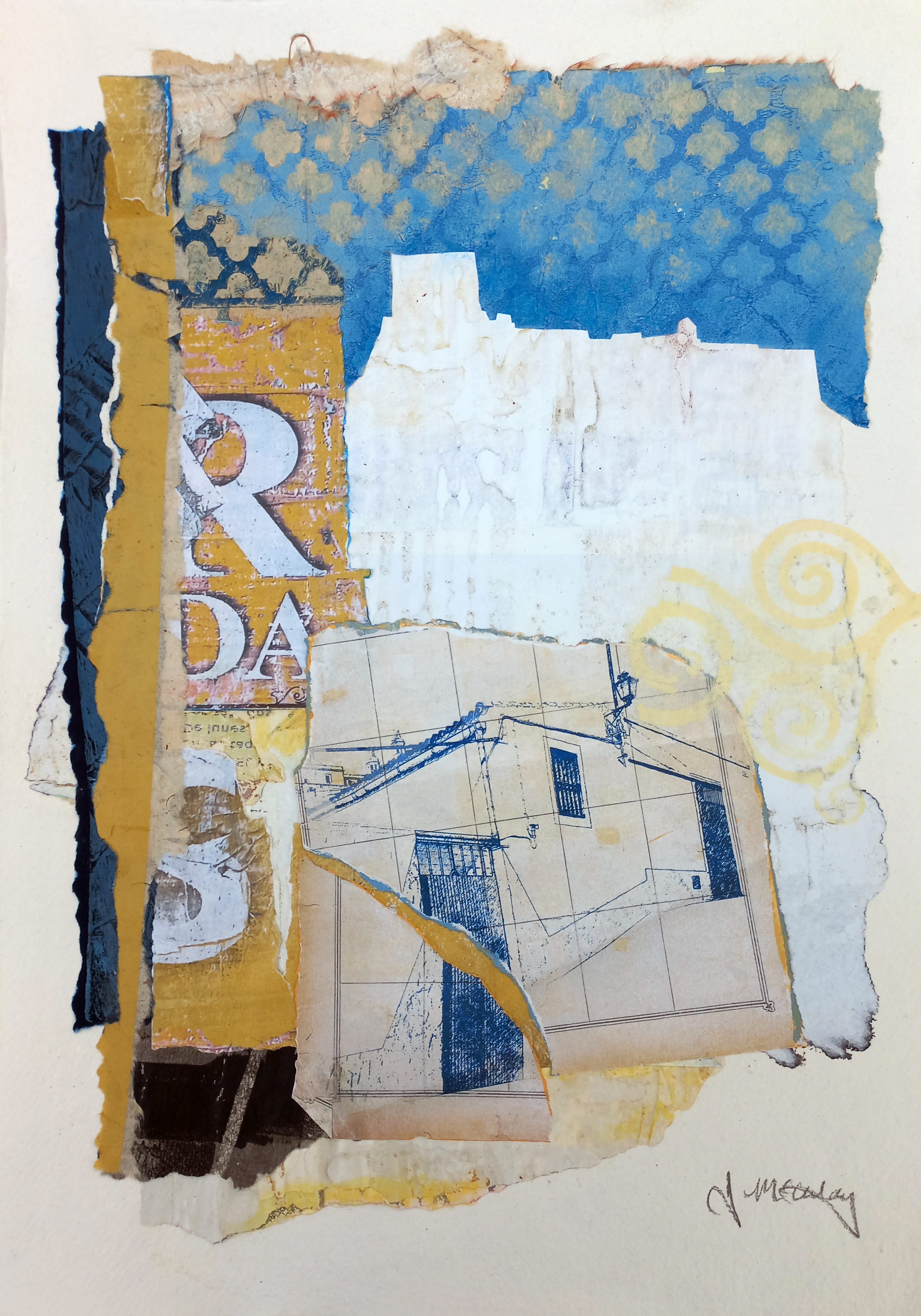
Traced Memory, 2025. Mixed media on paper.
A few thoughts
Limits don’t create ideas from nothing, but they can reveal what you were already leaning towards.
Removing something you rely on can show you what is really holding a composition together.
A restriction can expose whether colour, material or motif is strengthening the work — or quietly compensating for a weakness.
Questions to consider
■ If your work begins to feel unfocused, what might happen if you temporarily removed one element you regularly depend on?
■ What single restriction — of colour, format or material — might reveal how your compositions are actually functioning?