


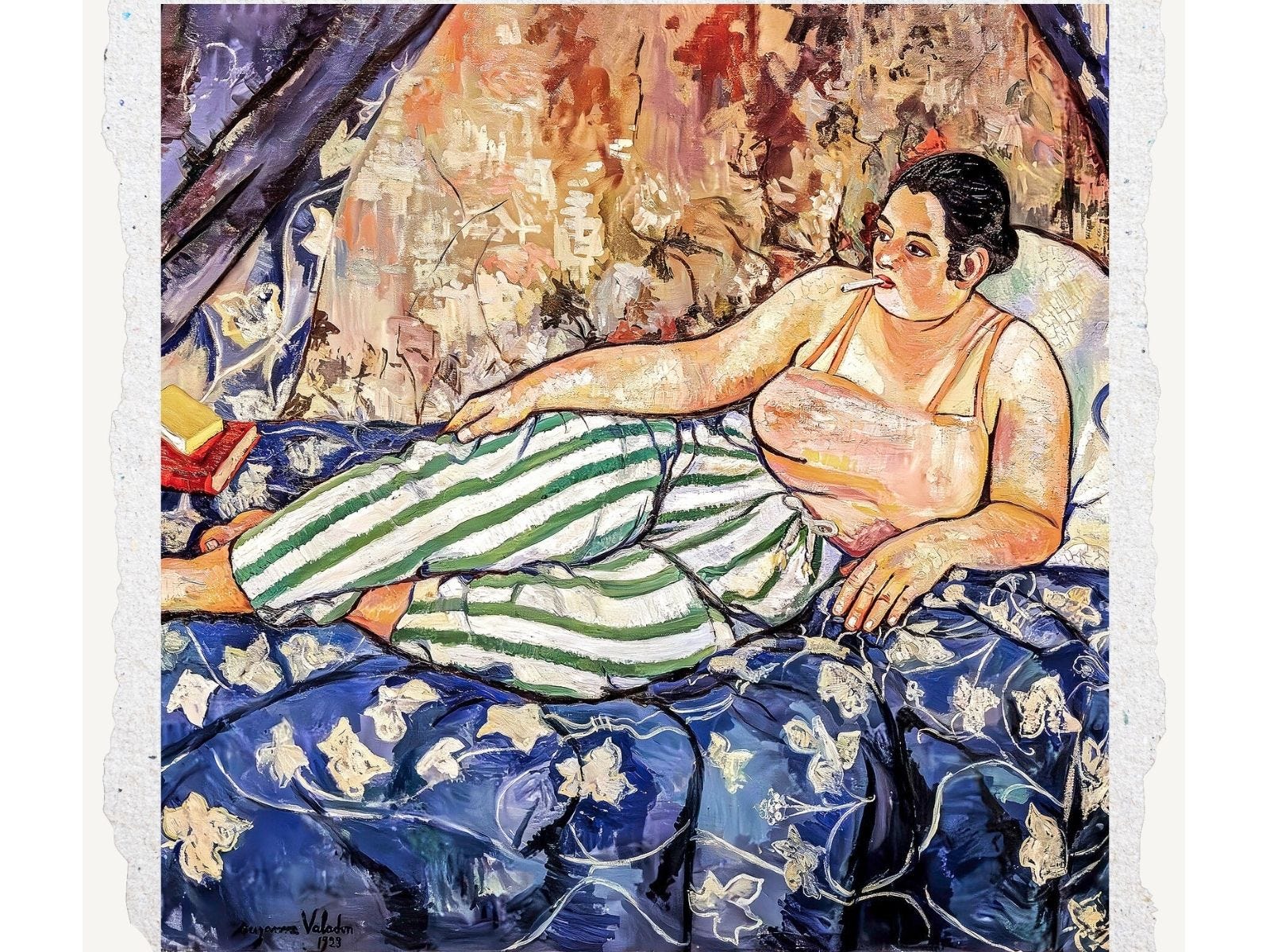
Suzanne Valadon, The Blue Room, 1923 (oil on canvas). Public domain.
First encounter
In 1996, while living in Switzerland, I visited an exhibition at the Fondation Pierre Gianadda in Martigny. It was a retrospective of Suzanne Valadon (1865–1938), and I was struck by the power of her work.
Despite having an MA in History of Art, I had not come across Valadon before. More broadly, I realised how unfamiliar I was with many female painters of that period.
Better-known contemporaries include Berthe Morisot and Mary Cassatt. Both had to fight hard within the male-dominated world of Impressionism. Morisot is quoted as saying that all she wanted was to meet a man who treated a woman as an equal. Yet both Morisot and Cassatt came from relatively wealthy backgrounds and benefited from private tuition. Their entry into the art world, while far from straightforward, was more supported than Valadon’s.
Valadon’s beginnings were very different. The illegitimate daughter of a laundress, she was raised in far less stable conditions. She showed an early ability to draw, using whatever came to hand, including coal. By around the age of fifteen, she was working as a circus acrobat, a profession she is said to have loved.
But a fall put paid to this career, and she became — as many vibrant and beautiful women of her time did — an artist’s model. She modelled for painters such as Toulouse-Lautrec and Renoir, moving within the artistic circles that would later shape her own work. Her personal life was equally complex. Her son, Maurice Utrillo — himself a painter — was widely thought to have been fathered by one of several artists in her circle before being recognised by the Spanish painter Miquel Utrillo.
What is striking is that Valadon did not remain a passive presence within that environment. She absorbed what she could, learned through observation and gradually shifted from model to artist.
In her work — particularly in her treatment of the figure — there is a robustness and directness that set it apart. The use of colour is often more assertive, and there is a grittiness that feels absent not only in the work of Morisot and Cassatt but also in that of many of their male contemporaries. There is little idealisation. The figures feel present rather than arranged.
Despite periods of difficulty, including an attempted suicide, there is a sense that she did not dwell on her circumstances. From early on, she was ambitious to be recognised as an artist in her own right. She absorbed what she learned as a model and, coupled with a strong and determined personality, developed a distinctive visual language — particularly evident in her treatment of the nude.
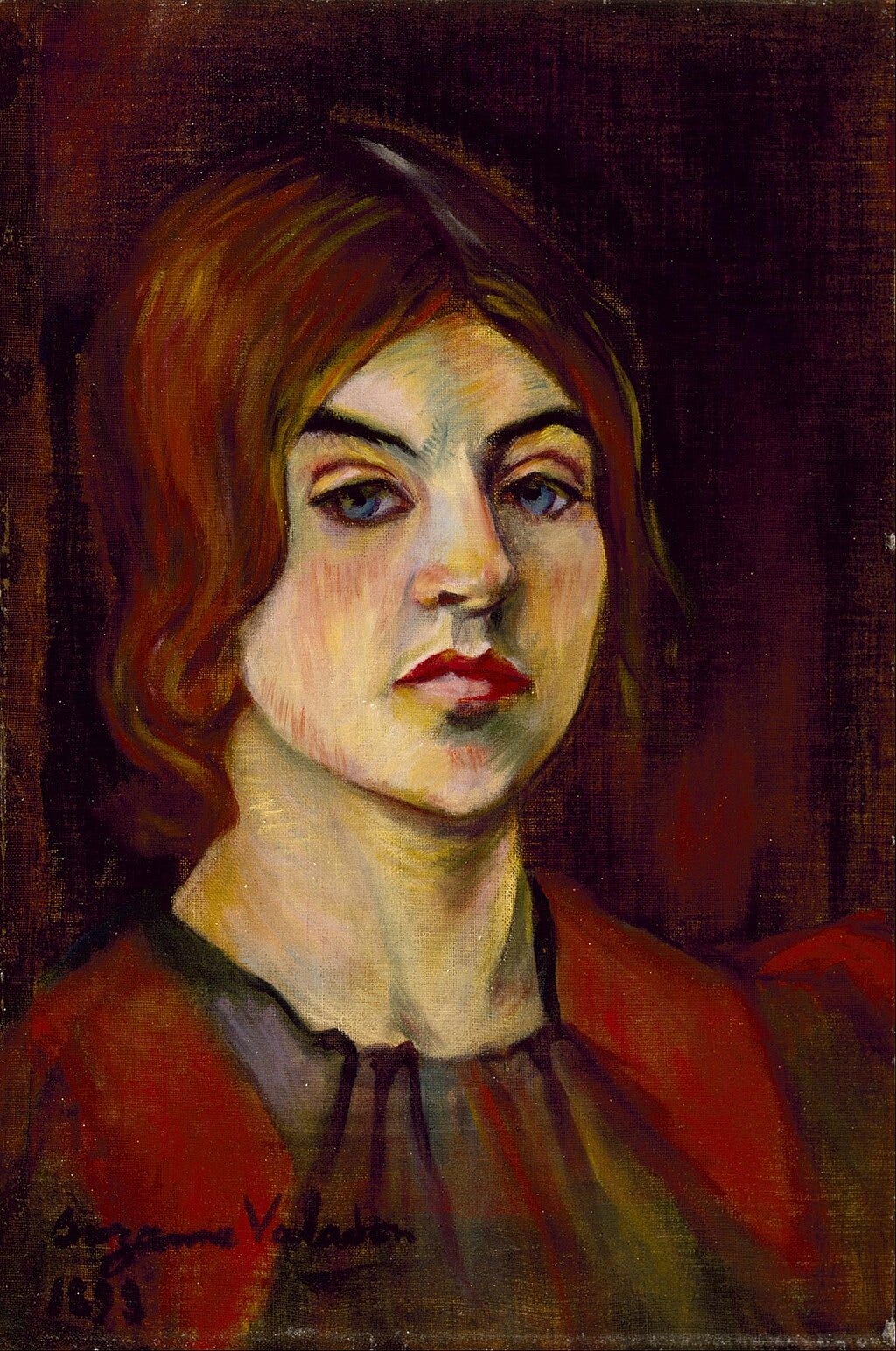
Suzanne Valadon, Self-Portrait, 1898 (oil on canvas). Public domain.
In her words:
“I had great masters. I took the best of them, of their teachings, of their examples. I found myself, I made myself, and I said what I had to say.”
Valadon was not an artist whose life ended in obscurity. Her work was exhibited at major salons, including the Salon d’Automne and the Salon des Indépendants, and in 1924 she secured a significant contract with the Parisian dealer Bernheim-Jeune.
A few thoughts
Valadon offers much for consideration. She clearly had natural ability, but without formal training it was her tenacity — and her ability to learn through observation and experience — that carried her through.
She did not follow a defined path into the art world. Instead, she worked from within it, gradually shifting her position and building something of her own. There is a level of independence in that which is not imposed, but developed over time.
Questions to consider
What carries more weight over time — natural ability or persistence?
How much do you rely on structure e.g. courses and workshops to improve, and how much comes from what you choose to explore on your own?