


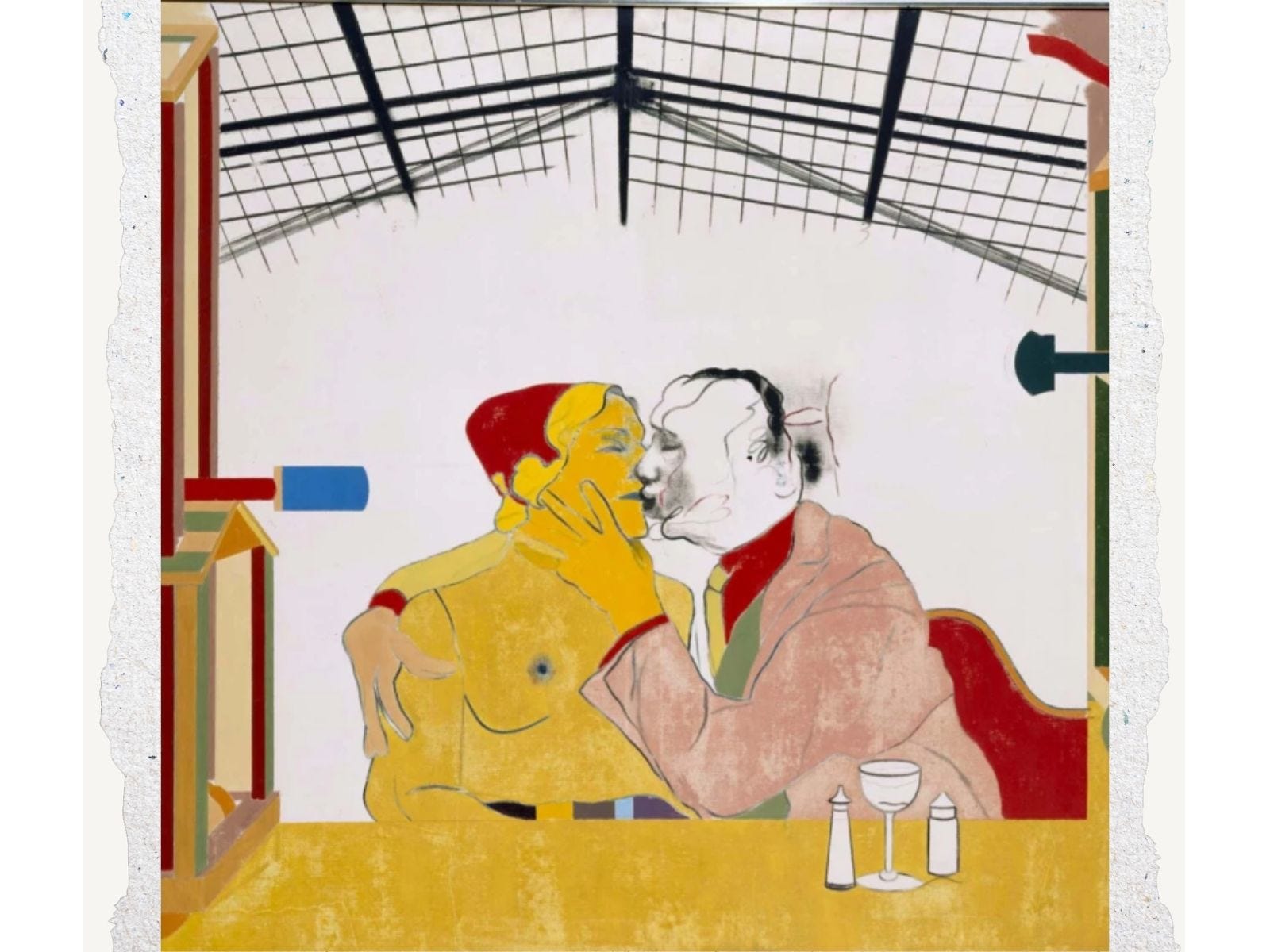
R. B. Kitaj, Where the Railroad Leaves the Sea, 1964, oil on canvas, Museo Nacional Centro de Arte Reina Sofía, Madrid — image used for commentary and educational purposes
First impressions
I first came across R. B. Kitaj (pronounced Kit-eye) at Hong Kong Art School, when a lecturer brought in a richly illustrated book. My History of Art degree hadn’t taken me much beyond WWII, but this didn’t feel new so much as different. What struck me immediately was the strength of colour, the architectural structure of the work, and the ease with which he moved between painting, drawing and printmaking — a quiet level of competence and craftsmanship that avoids tipping into display or virtuosity for its own sake.
It’s hard to think of many artists where this movement across media feels so fully absorbed into the work, rather than presented as skill. It felt like a distinct voice. He remains an artist I return to.
Background and position
Kitaj was an American with Jewish roots who went to England to study and stayed for 35 years. He was associated with the British pop art movement and, indeed, had an influence on it. However, his strong love of figurative painting, coupled with an academic interest in the history of art, made him — as with David Hockney — unfashionable at a time when pure abstraction and minimalist aesthetics ruled the day.
Alongside Patrick Caulfield and Ridley Scott, Kitaj first met Hockney at the Royal College of Art (1959–61) in London. Hockney became a lifelong friend and supporter of Kitaj, and support was something the painter couldn’t have too much of in 1994, the year of his first major retrospective at the Tate.
Criticism and backlash
What should have been a proud, lifetime achievement was destroyed by the critics. The attacks were both brutal and personal, and not solely from the likes of the acerbic and elitist Brian Sewell. Andrew Graham-Dixon, one of my all-time favourites, weighed in, calling Kitaj “a small man with a megaphone pressed against his lips.” I remember finding that surprising at the time — not because critics can’t be savage, but because it felt so pointed.
The “vicious” assassination, as Hockney described it, could not realistically have been a comment on Kitaj’s artistic output. A year later, the artist received the Golden Lion award at the Venice Biennale (1995), where Robert Hughes (author of The Shock of the New) commented that he drew better than almost anyone alive.
It seems more likely that the critical hostility arose from the lengthy written explanations Kitaj provided — on the advice of the then Tate director. Perhaps the critics felt that words and explanations were their domain, or they simply disliked the sometimes large and unpleasant ego that Kitaj could project in his writing.
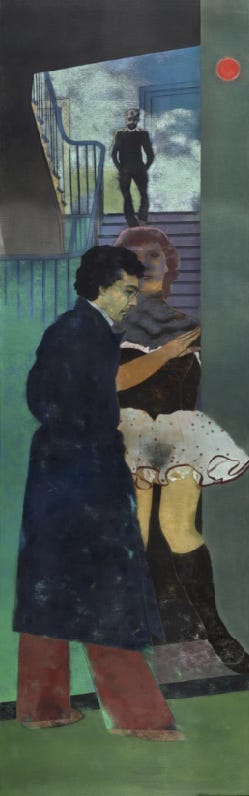
R. B. Kitaj — Smyrna Greek (Nikos), 1976–1977, oil on canvas, Museo Nacional Thyssen-Bornemisza, Madrid. Image used for commentary and educational purposes.
Aftermath
Whatever the reasons, in many ways Kitaj never really recovered emotionally. His wife, Sandra Fisher, who had been heavily involved in the setting up of the Tate retrospective, died two weeks after the show opened from brain damage. Kitaj blamed the critics, returned to the USA, and took his own life in 2007.
Separating artist and work
I don’t believe you have to like an artist to admire their work. If racism, misogyny, immorality — and the occasional over-bearing ego — were to decide an artist’s role in history then most by now would be “cancelled” and the art history books very empty indeed. The same thing could be said of art critics too.
However, it’s a more complicated question now than it once was.
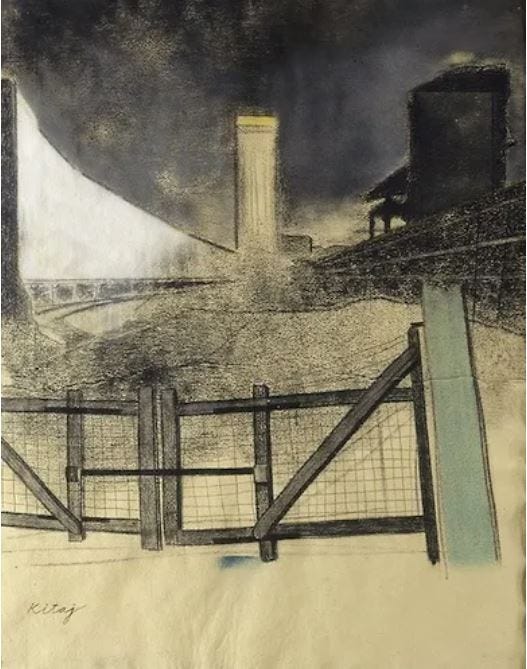
R. B. Kitaj, Drancy, 1984–86, pastel and charcoal on paper, 39 × 30¾ in., Jewish Museum Berlin, Berlin — Image used for commentary and educational purposes
A few thoughts
It’s worth considering the role of writing in a painter’s practice. Kitaj saw painting as “a great idea [he carried] from place to place / like a refugee’s suitcase”. Reading and writing were central to both his life and his work.
The question is not whether the writing was good or bad, but what it does. At what point does explanation begin to direct the work too heavily, or close down interpretation rather than open it?
It’s something I’ve gone back and forth on over time.
Questions to consider
■ As artists, how much do you want to explain your work — and at what stage?
■ Does writing alongside your work help clarify what you’re doing, or does it risk fixing meaning too early?