


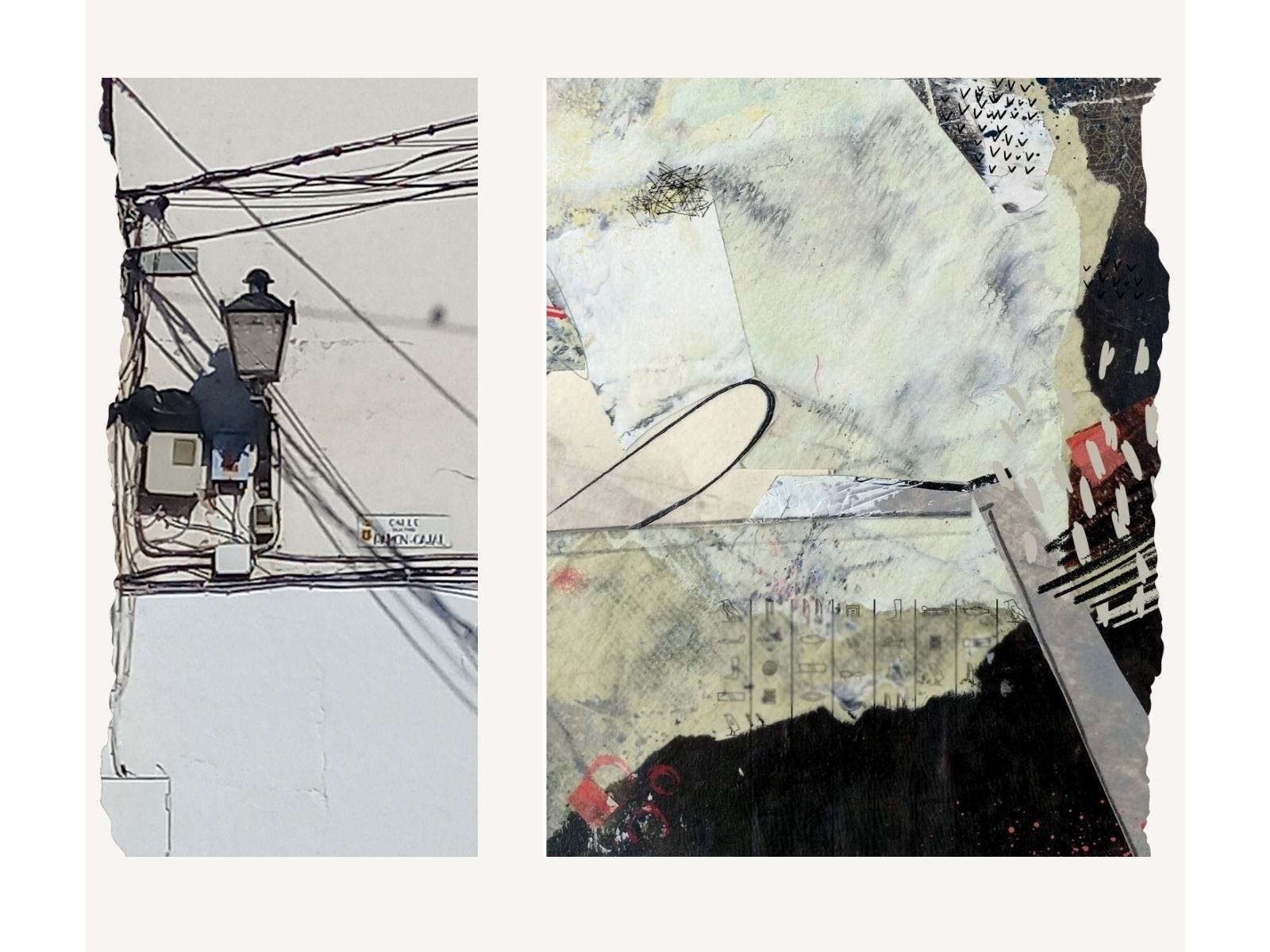
Work by the artist, 2024
Defining the artist’s eye
An artist’s eye is not simply the ability to see. It is the habit of noticing what repeatedly draws your attention — and choosing to respond to it.
At different stages of artistic development — early or late — many artists find themselves collecting: photographs, sketches, scraps of magazine pages, texture and colour notations. Consciously reacting to what interests or inspires you is an important part of artistic development. It sharpens attention and begins to reveal preference.
What often feels less clear is what comes next.
What follows is not invention, but distillation — the gradual refinement of what has already been there.
Literal beginnings
In many cases, the first response to source material is more literal. We try to translate what we see directly. There is nothing wrong with this. Every piece teaches you something. It helps filter your interests and refine what holds your attention.
A well-known example of this gradual shift is Piet Mondrian (1872–1944). Early in his career, he was absorbed by the structure of trees — the rhythm of branches against the sky. The motif stayed with him for years, but the form steadily simplified. By the time we reach the grid paintings — black lines intersecting with blocks of primary colour — the trees are no longer visible, yet the underlying rhythm remains.
The subject did not disappear. It was distilled.
Distillation results in different forms for different artists. For Mondrian, it was structural rhythm. For Mark Rothko (1903–1970), it became colour and atmosphere. For Giorgio Morandi (1890–1964), it was tonal restraint and spatial quiet. What remains is not always structure. It may be colour, tension, repetition, surface or scale — whatever element held the strongest pull from the beginning.
A personal turning point
A pivotal moment in my own work came when I encountered a derelict house during a short period at the École des Beaux-Arts in Toulouse. Three outer walls had been demolished. What remained were marks — traces of a stairwell, outlines of doors, fragments of patterned wallpaper clinging to exposed surfaces.
My early responses were overly literal and not especially successful. I was attempting to reproduce what I saw. Over time, I realised I was not just drawn to texture, but to the idea of fragments — partial histories, structures revealed through loss.
With a handful of poor-quality photographs, I returned to the subject repeatedly and began noticing similar spaces elsewhere. Years of sketching, layering and reworking followed before I understood how central this theme of deterioration had become. It was not a decision made in advance. It accumulated gradually through working.
The slow work of distillation
The development of a personal visual language is rarely dramatic or instant. For most artists, it takes years. Distillation rarely happens quickly. It often becomes visible only in hindsight.
In my own work now, what holds my attention most strongly are layers of time — surfaces that have accumulated change, weathering, removal and addition. The interest is not in the object itself, but in what has shifted.
These fragments are not copied directly. They are absorbed, layered and reworked until the source is no longer obvious — though its influence remains.
This is not about style as surface. It is about personal visual syntax — the structural habits that emerge through repetition. Even during periods when there is little time to make work, the habits of noticing and refining continue quietly in the background.
A few thoughts
Literal work is part of refinement.
Repetition is a form of investigation.
Distillation requires patience.
Questions to consider
■ What keeps resurfacing in your work — a colour, a surface, a structural rhythm, a mood? Try to identify three elements you consistently gravitate towards.
■ Are you still reproducing what you see, or beginning to translate what draws you to it? What feels like the strongest pull at the moment?