



What Are Complementary Colours?
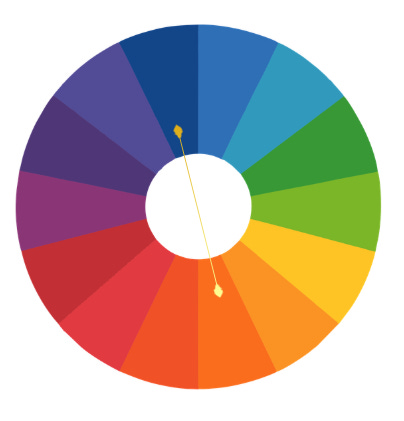
Complementary colours are colours that sit opposite each other on the colour wheel. When placed together they create strong visual contrast; when mixed they produce a range of muted tones and greys. For this reason complementary pairs are often used to build simple, controlled palettes in painting.
Palette Solutions: Colour Roles in a Painting
Many painters struggle with colour because they try to use too many colours at once.
A useful alternative is to build a painting around complementary colours and assign each colour a role within the composition.
Instead of asking:
What colour should this object be?
Try asking:
Which colour in my palette will represent this object?
Working with complementary colours simplifies colour decisions and often produces a more unified painting. With the palette established, you are freer to explore composition, structure and the relationships between elements in the image.
Example 1: Complementary Colour Roles in a Still Life
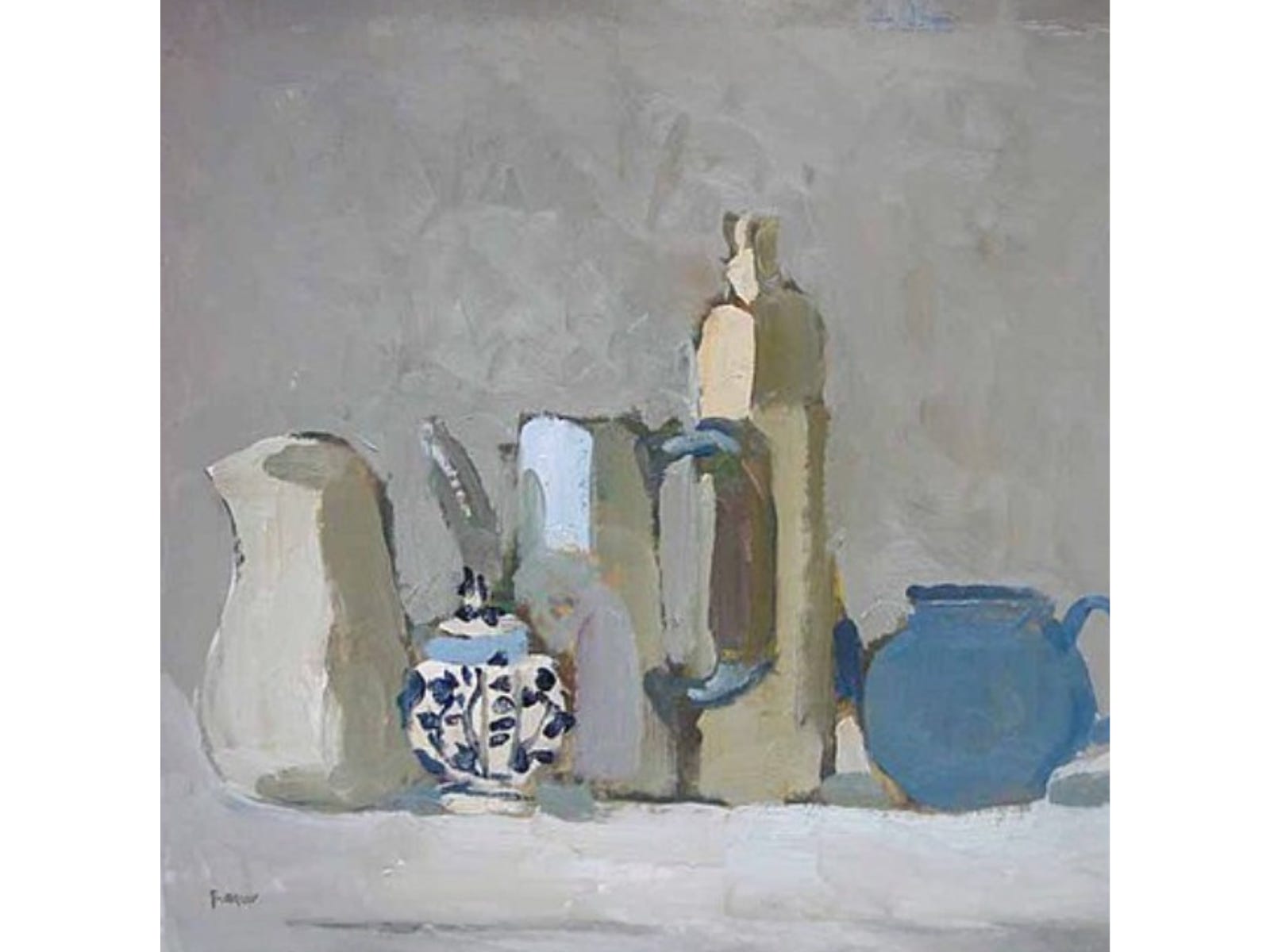
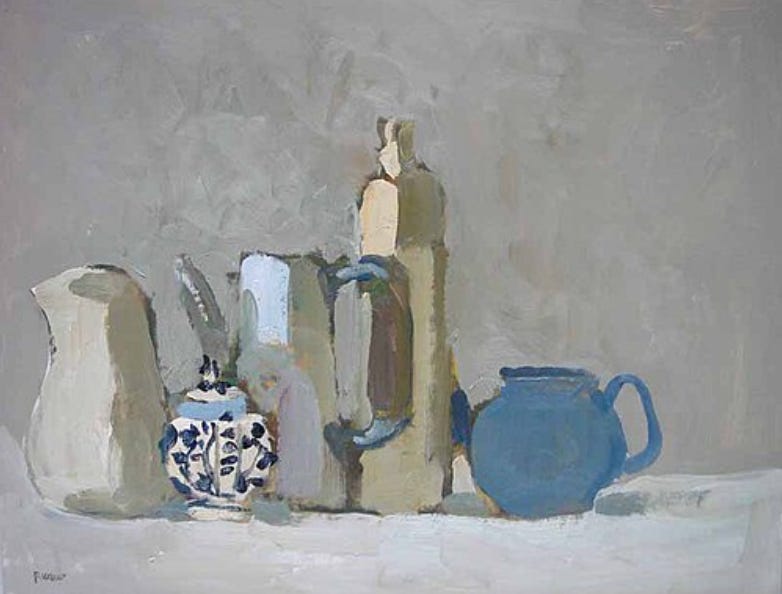
This still life by the French artist Pierre Coquet (1926-2021) shows how effective this approach can be.
The palette is largely built from:
Blue
Yellow-orange
Greys mixed from the two colours
Rather than describing objects literally, the colours take on specific roles within the composition.
Colour Roles in the Painting
Focal object (the teapot)→ Blue
Secondary objects → Muted yellow-orange (also greys, very light blue)
Background and supporting areas → Mid grey mixtures
Table surface → Light greys
Shadows → Darker greys
Because the palette is restricted, the painting feels calm and unified.
Controlling Colour Intensity

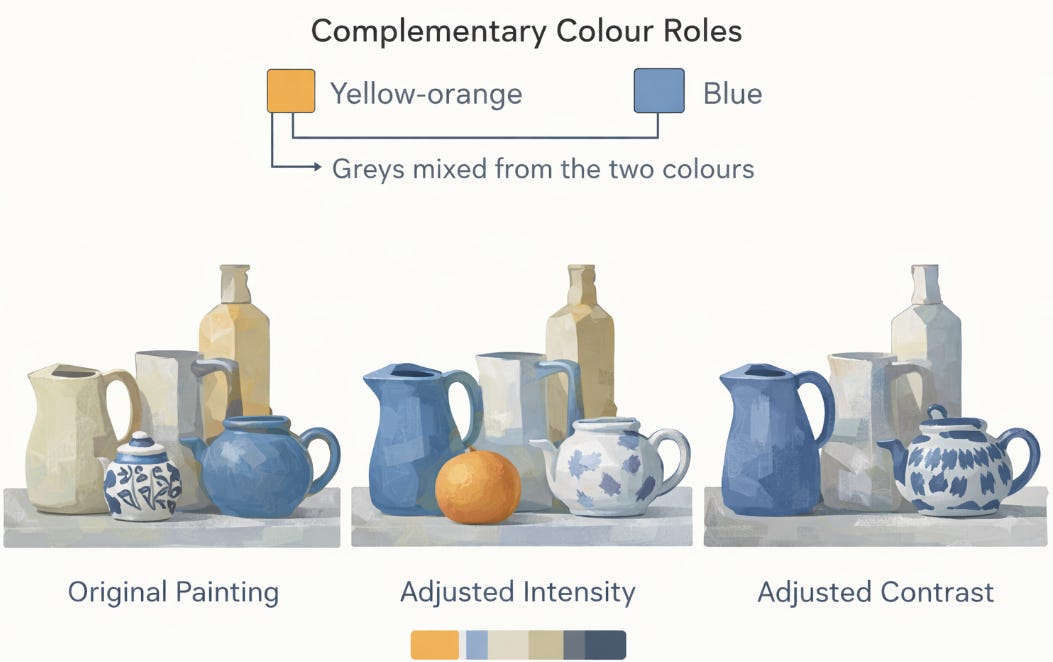
It is also worth noticing that the blue used here is not a strong primary blue. A small amount of its complementary colour — in this case a yellow-orange — has quickly softened or “knocked back” the blue.
The same works in the opposite direction.
If we imagine an orange placed in front of the teapot, adding a small amount of blue to the yellow-orange would also reduce its intensity. In this way two strong colours can be gently adjusted so that neither overwhelms the painting.
This is one of the most useful qualities of complementary colours: they allow the artist to control colour intensity while keeping harmony within the palette.
Value Contrast and Focal Point
Another interesting aspect of this painting is where our eye is drawn.
Even though the blue teapot is the strongest colour, it is not the first object we notice. Instead, the eye moves immediately to the small ornamental ginger jar.
This happens because the jar contains the strongest value contrast in the painting: dark blue decorative marks placed against a light white surface. Our eye is naturally attracted to areas where light and dark meet sharply. In this case, value contrast is more powerful than colour. This shows that even within a restricted and muted palette, a painting can still contain a great deal of visual variation.
It also raises an interesting question.
What might happen if the teapot carried the strongest value contrast instead?
Or if the teapot remained blue but one of the other objects took on that role?
Small shifts like this can change the entire visual balance of the painting.
Example 2: Complementary Colour Roles in a Landscape
While the Coquet still life demonstrates how complementary colours can organise a small group of objects, this harbour scene by Paul Signac (1863–1935) shows how the same principle can structure an entire scene.
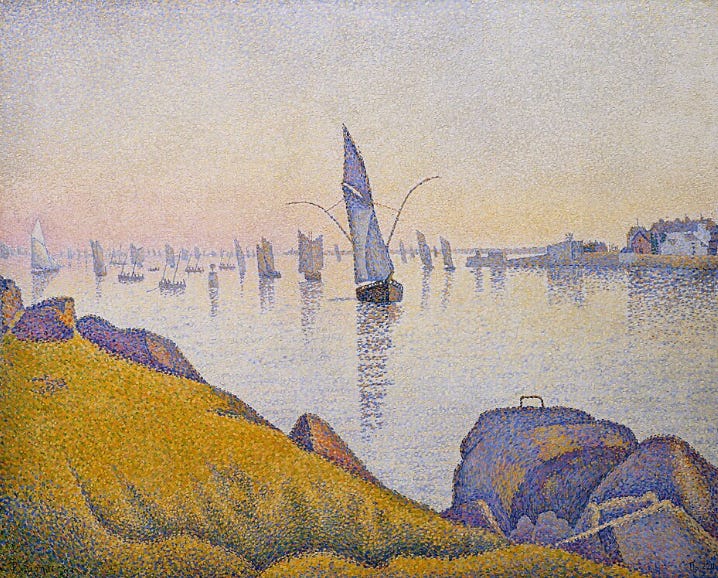
Although the scene contains many colour variations, much of the painting is structured around a complementary relationship between:
Yellow
Violet
Greys (visually mixed)
Unlike the Coquet still life, where the colours are physically mixed on the palette to create greys, here the greys emerge through optical mixing. Small dots of yellow and violet sit side by side, and when viewed from a distance the eye blends them into soft neutral tones.
Colour Roles in the Painting
Foreground slope → Yellow and yellow-orange
Foreground rocks → Violet and blue-violet
Water and distant boats → Cool blue-violet mixtures
Sky → Very pale mixtures of yellow and violet
Reflections and transitional areas → Soft grey mixtures of the two complements
Warm and Cool Colour Contrast
Another interesting feature of this painting is the warm–cool contrast created within the complementary palette.
The foreground slope and the rocks are painted with a similarly dense application of colour. However, the two areas behave very differently visually.
The yellow vegetation appears to advance in the picture space because yellow is a warm colour.
The violet rocks appear to recede because violet is cooler.
Even though the areas are treated in a similar way, the difference in colour temperature creates a subtle sense of spatial depth.
Exercise: Using a Limited Palette
The two examples above show how painters can organise a composition using a limited palette and by assigning colours clear roles within the painting.
Step 1— Choose One Colour
Start with one colour you enjoy working with, preferably something slightly muted.
Examples:
Muted blue
Dusty rose
Soft olive
Warm ochre
This becomes the anchor colour of the painting.
Step 2 — Find Its Complement
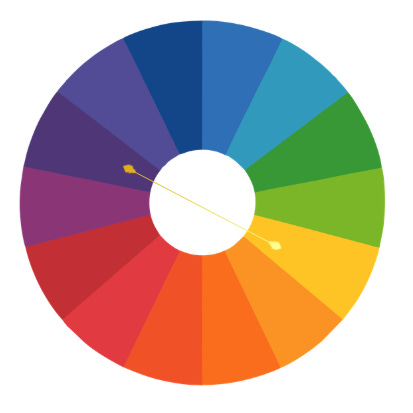
Use a colour wheel to identify the complementary colour.
Complementary colours sit opposite each other on the colour wheel.
Examples:
Blue → orange
Red → green
Yellow → violet
This complementary colour will form the second colour in your palette.
Useful Colour Tools
These tools allow you to select a colour and see its complementary colour directly on the wheel.
Step 3 — Create Colour Strips
Create three horizontal strips, each divided into nine equal squares.
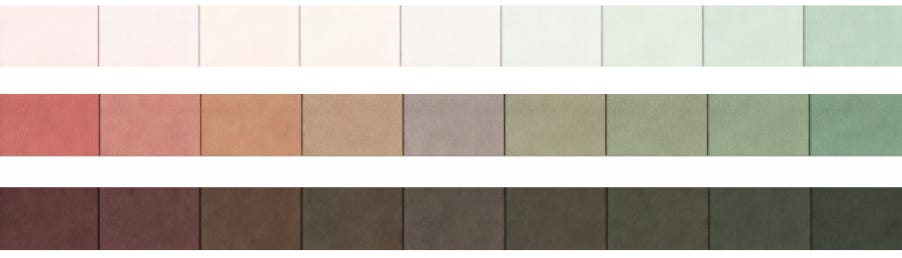
Middle Strip
Place the pure colours at each end of the strip.
Square 1 → your chosen colour
Square 9 → its complementary colour
Next mix the two colours in equal proportions and place this mixture in the centre square (square 5). This mixture should produce a neutral grey or muted colour.
Then, fill the remaining squares between the ends and the centre.
Moving from square 1 toward the centre, gradually add increasing amounts of the complementary colour.
Moving from square 9 toward the centre, gradually add increasing amounts of the first colour.
Each square should contain a slightly different mixture so the colour gradually shifts from one end of the strip to the other.
Upper Strip
Repeat the same sequence of mixtures.
This time add a small amount of white to each colour.
Lower Strip
Repeat the sequence again.
This time add a small amount of black to each colour.
Observations
Together these three strips create a small family of related colours.
Even with only two colours, a surprisingly wide range of muted tones and greys can be produced. This exercise shows how much variety can emerge from a very limited palette.
Step 4 — Choose a Simple Structure
Begin by making several small thumbnails of a simple composition.
You might choose:
a small still life with two or three objects
a simplified landscape with foreground, middle ground and sky
an abstract arrangement of shapes or bands
Keep the structure simple so you can focus on the colour relationships.
Step 5 — Assign Colour Roles
Use the colours from your strips to organise the painting.
For example:
Main object or dominant area → anchor colour
Secondary elements → complementary colour
Background areas → grey mixtures from the strip
Stay within the colour family you have created and using the still life teaching diagram as a reference, try making small changes to the composition.
add another object
shift which element uses the anchor colour
change where the strongest value contrast occurs
Step 6 — Make a Small Painting
After you have made one or two pages of thumbnails, choose the most successful composition and use it as a guide to make a small painting. Do not try to copy the thumbnail exactly; use it as a starting structure for exploring colour and design relationships.
Exercises like this reveal how much variation can emerge from only two colours. Limiting the palette often produces a more unified and coherent painting, allowing the artist to focus more carefully on structure, value relationships and the balance between elements in the composition.

Your Turn
If you try this exercise, please share your experience in the comments.
What did you learn from working with a complementary pair?
Did anything surprise you while mixing the colours?
Was anything more difficult than you expected?
You can also leave a comment about any aspect of colour, mixed media painting or drawing you would like to explore further.